

Fashion's Hidden Price Tag: Talking at Barcombe Eco Fair
Opinion & views | Reading time: 6 minutes | Topic: Fast Fashion, Waste Colonialism, Circular Economy
I give this talk for free. I've done it at village halls, school events, community gatherings across Sussex. I do it because I started my career in fashion marketing, which means I learned things I really couldn't unsee, and once you have that information, doing nothing with it feels like a choice.
In March it was Barcombe Eco Fair. Green Barcombe is a community group doing something I have a lot of time for: getting neighbours engaged, in a hands-on way, not just vaguely concerned. I called the talk "Fashion's Hidden Price Tag." Here's what I told them:
I started with a number I thought most people would have heard before. The fashion industry is responsible for 10% of all global CO2 emissions. More than all international flights and maritime shipping combined.
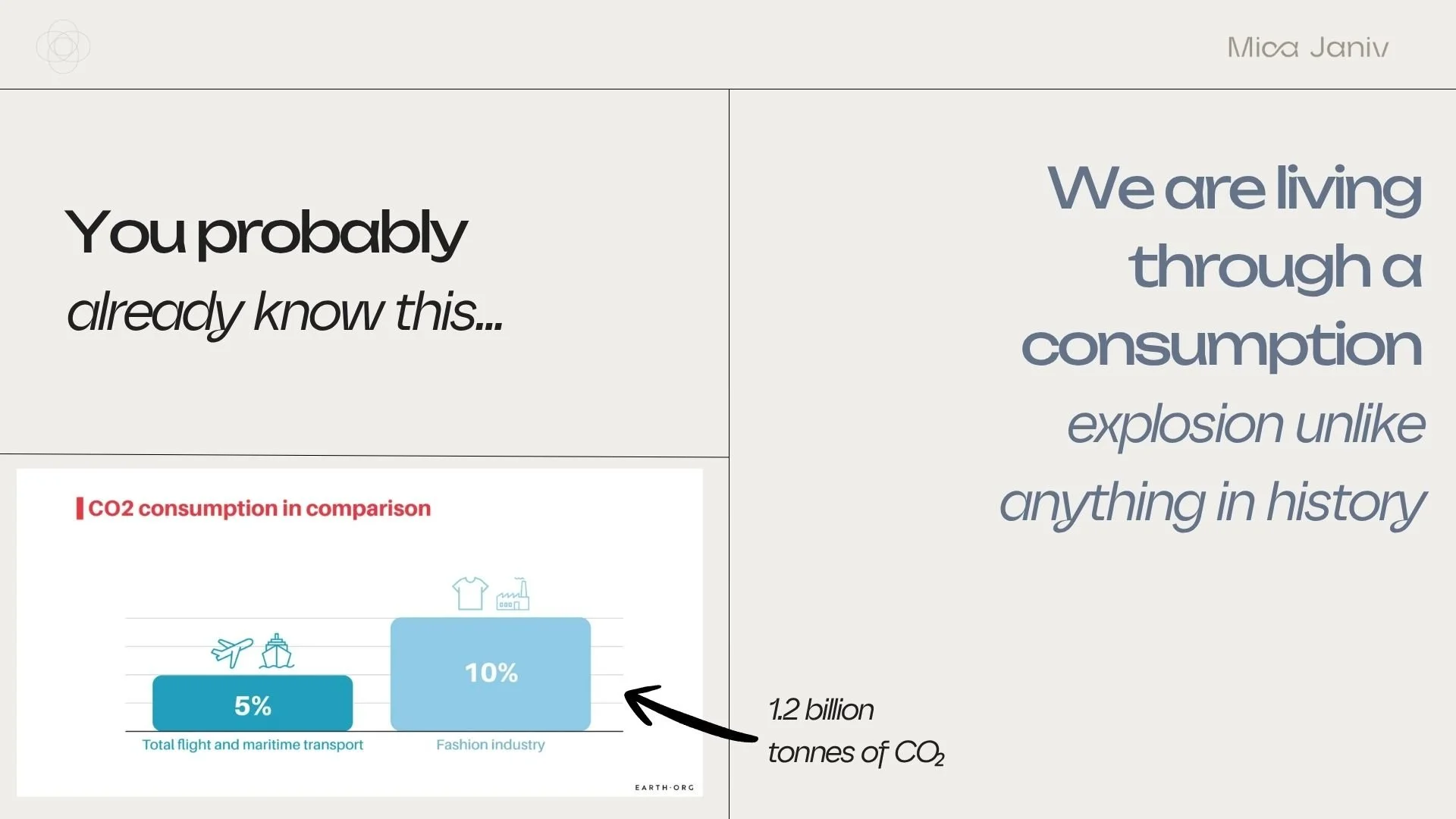
Source: Fast Fashion's Detrimental Effect on the Environment - Earth.org
The room went very quiet. Nobody had heard it. And that's the thing. We put enormous cultural energy into people's flying habits, the guilt, the conversations, the carbon calculators. Fashion produces more than all of that and barely comes up at the dinner table. That's not an accident. We'll come back to that.
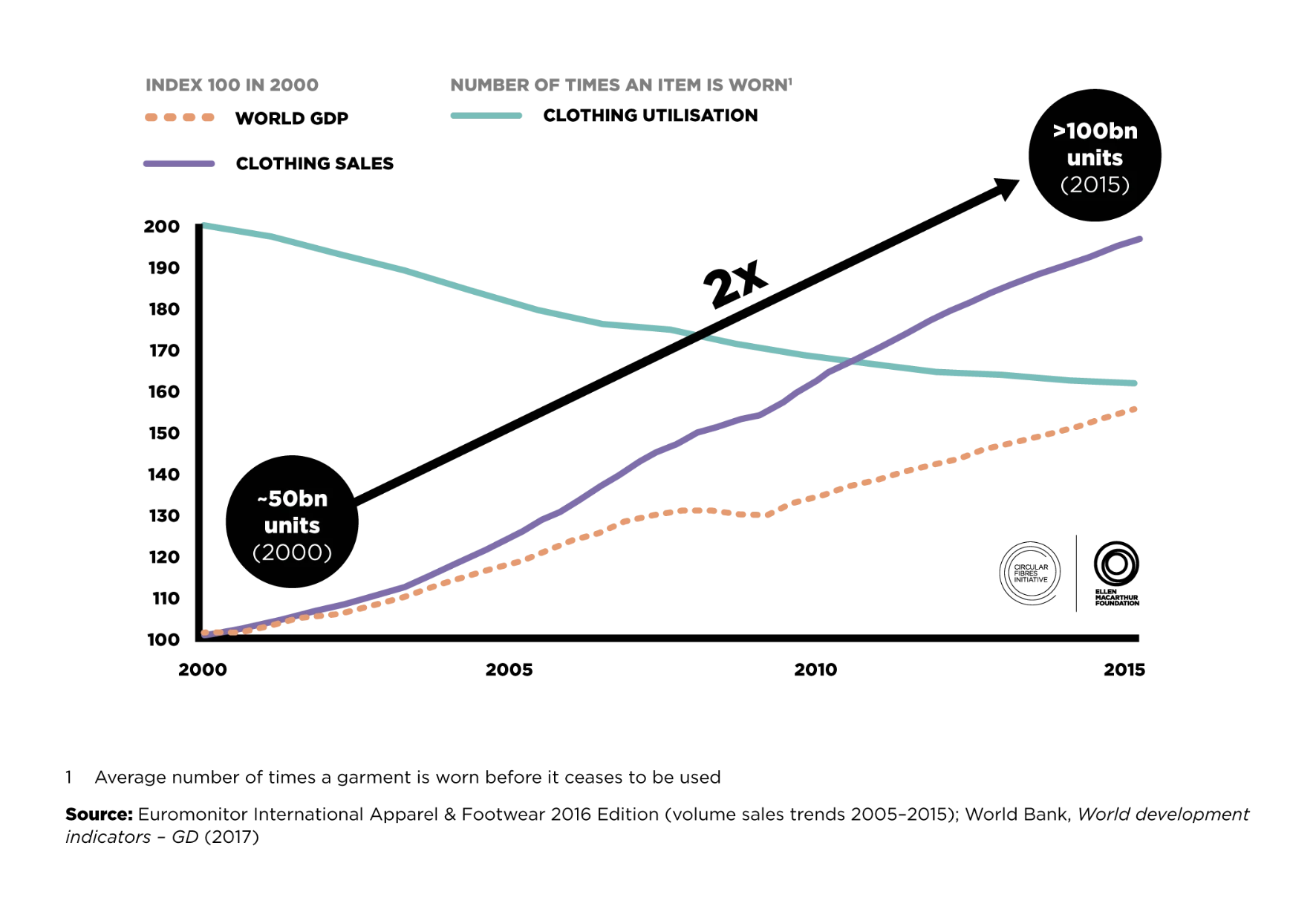
Here's another one: between 2000 and 2014, clothing production doubled, while each item is kept for half as long. If current production trajectories continue, by 2050 we will be manufacturing 138 billion garments per year that nobody ever wears.
Then I went somewhere most people don't expect.
The charity shop myth.
We donate in good faith. We picture our old clothes finding a new home. The reality: only 10% of donated clothes are actually resold in UK charity shops. The rest is baled up and shipped, mostly to the Global South, often under the framing of "aid."
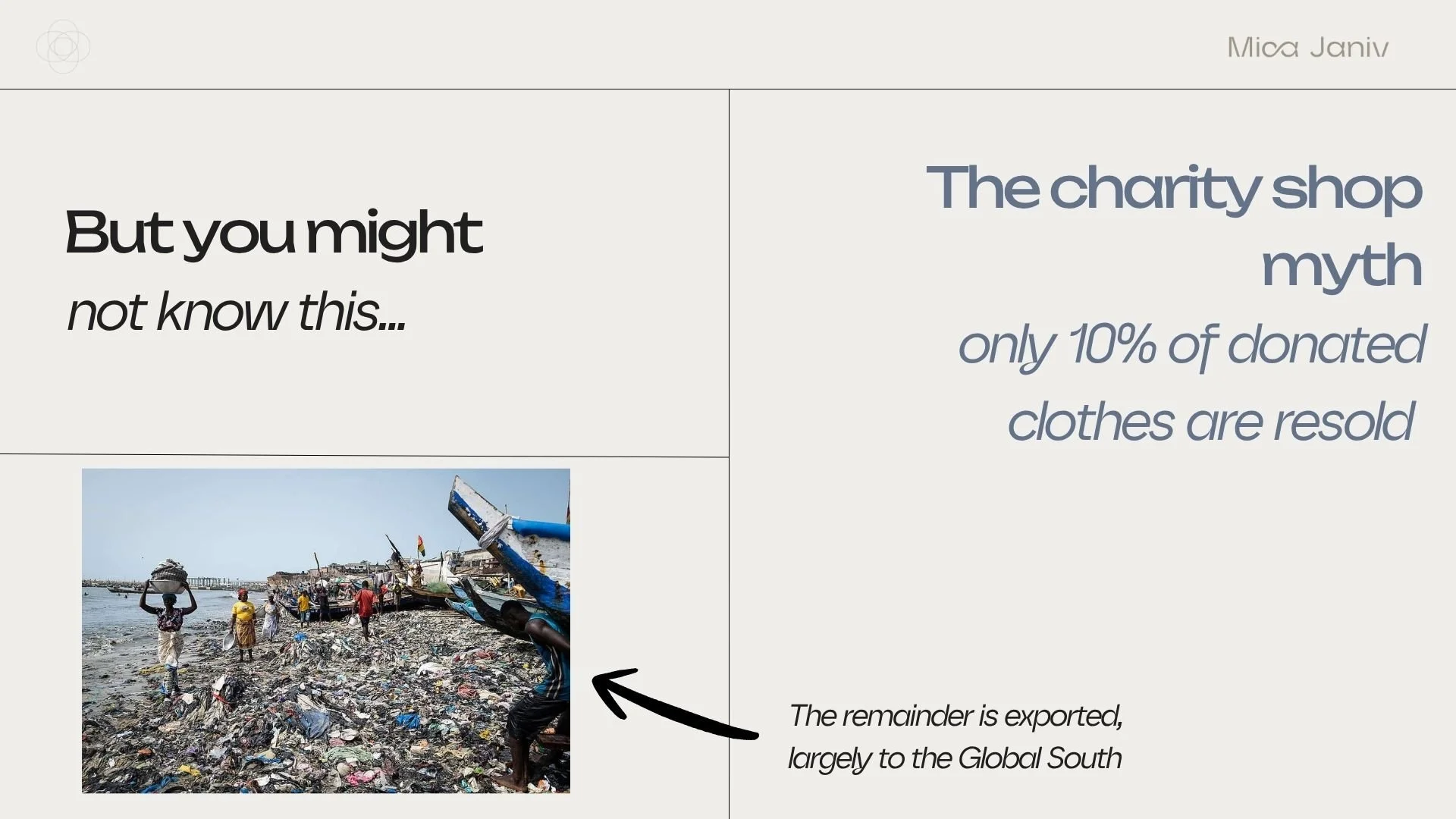
That framing is worth examining. Because what arrives isn't aid. A lot of it is unwearable, out of season, or simply not wanted. The Kantamanto market in Accra, Ghana, receives fifteen million items every single week, mostly from the UK and Europe. Forty percent go straight to landfill on arrival. The traders who bought the bales, who spent money they often couldn't afford on a gamble, are left with waste they cannot sell and cannot afford to dispose of properly. At the Kantamanto market in Accra, 15 million items arrive per week. 40% go straight to landfill.
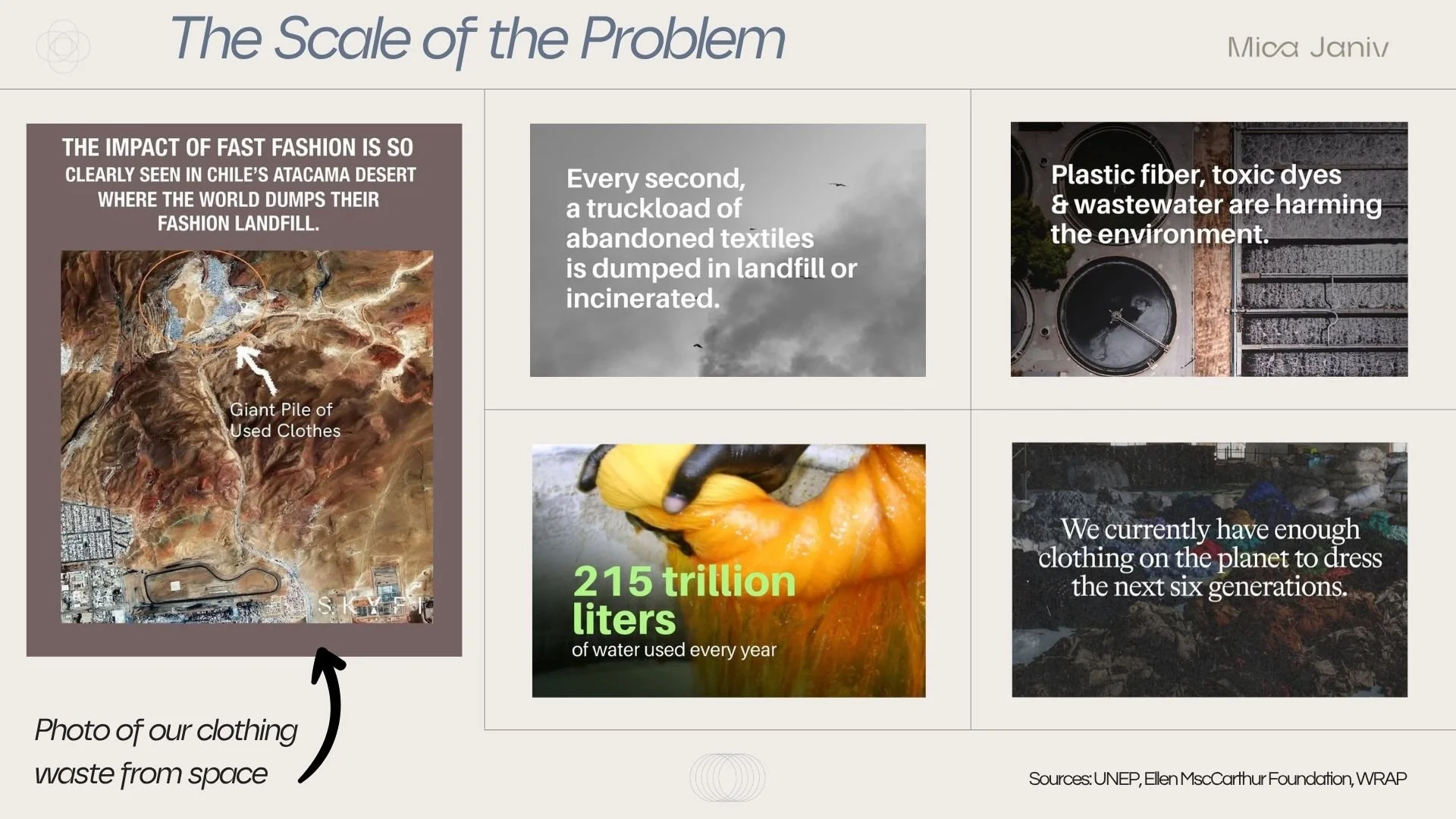
The most visceral example is the Atacama Desert in Chile. 39,000 tonnes of clothing are dumped there illegally every year, piles spanning three square kilometres, some reaching five or six metres high, visible from space. They burn. When they do, toxic fumes drift into the homes of 130,000 people in Alto Hospicio, one of Chile's poorest cities. Researchers who documented the site wore hazmat suits. Within an hour they'd identified H&M, Adidas, Levi's. Not obscure brands. The labels in most of our wardrobes.
There's a name for this: waste colonialism. The wealth from fashion accumulates in Europe and America. The toxic cost lands in communities that didn't generate the problem and have no political power to refuse it.
How did we end up here?
The fast fashion industry didn't invent manipulative marketing. It inherited a very deliberate toolkit, one built by Edward Bernays, Sigmund Freud's nephew, who figured out in the 1920s how to bypass rational decision-making by targeting the unconscious. He called it "the engineering of consent." Fast fashion doesn't sell you a jacket. It sells you the feeling that without the jacket, you're somehow incomplete. The insecurity isn't a side effect of the marketing. It's the point of it.

That's why shifting this requires more than individual choices. Which brings me to the news I found energising to deliver, after all that gloom.
The EU has just passed binding legislation that could change this at scale. These are not voluntary pledges. Here's what's coming, and when.
From January 2025, EU member states are already required to collect textiles separately for reuse and recycling. That's already law.
The destruction of unsold goods is banned under the Ecodesign for Sustainable Products Regulation (ESPR), which came into force in 2024. Brands can no longer incinerate or landfill new, tagged stock. Burberry alone destroyed £90 million worth of its own products in 2018 before the public scandal forced them to stop. That practice is now illegal across the EU.
By June 2027, all EU member states must have written Extended Producer Responsibility schemes into national law, with fees on producers fully operational by April 2028. The polluter pays principle, applied to fashion for the first time. Brands fund end-of-life recycling for their own garments.
And digital product passports will be mandatory for all textiles from around mid-2028: every garment must display its materials, carbon footprint, and recyclability. No more hiding behind vague eco-friendly language.
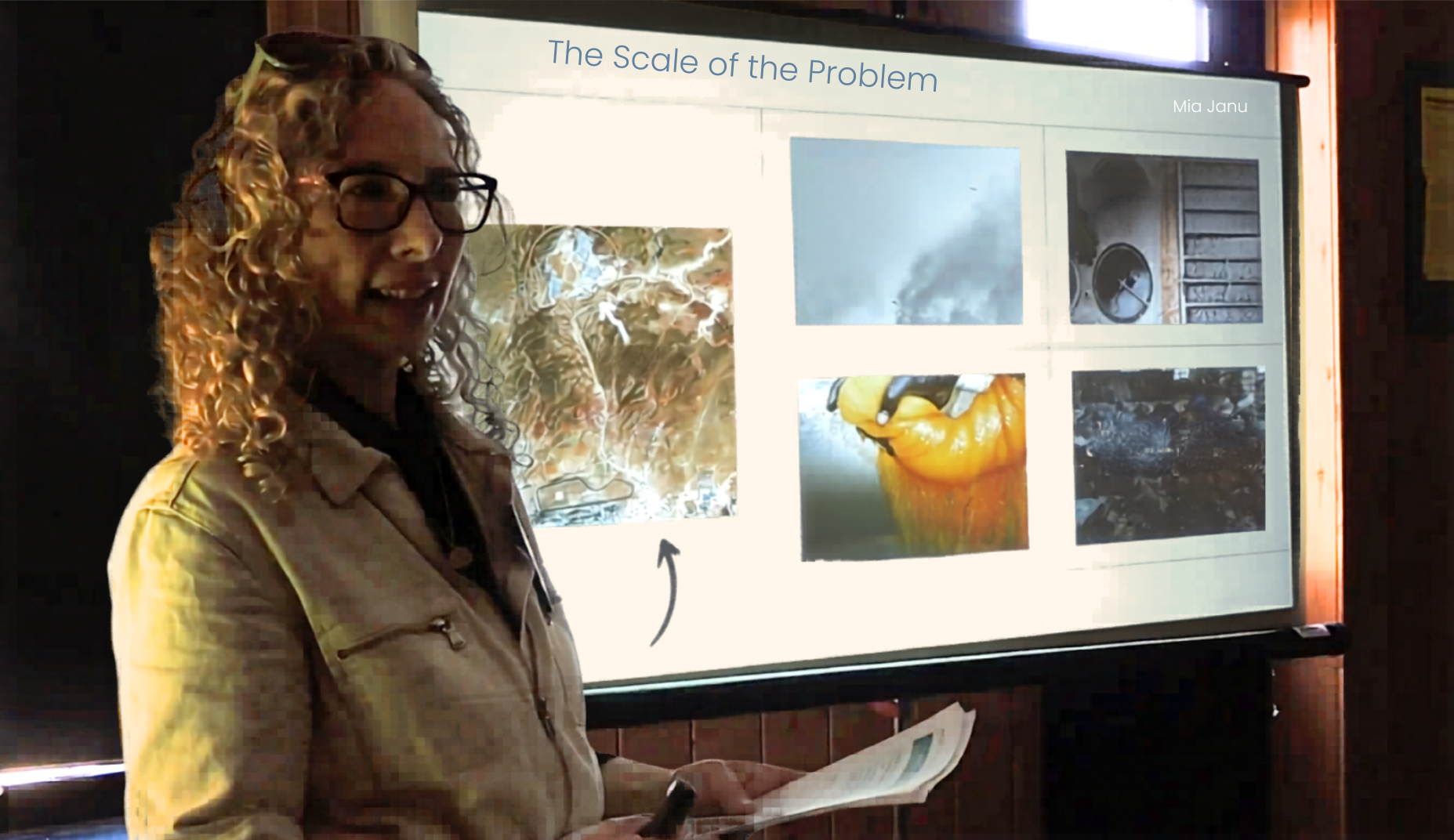
Here’s a pic of me at Barcombe Eco Fair, getting excited about Extended Producer Responsibility :)
The UK, post-Brexit, does not have these rules. What we have is the Green Claims Code, guidance from the Competition and Markets Authority. The CMA's own research found that 40% of green claims made online could be misleading. That's guidance, not law. The case for the UK to match EU legislation is unanswerable, and writing to your MP is one of the highest-impact things you can do beyond your own purchasing choices.
And some more good news
WRAP, the UK's Waste and Resources Action Programme, has done the numbers on what repair actually saves. Mending a waterproof jacket saves 45kg of CO2. That's the equivalent of not running your washing machine 300 times. A cotton t-shirt: 7.5kg CO2, equivalent to 25 hours of ironing. Darn a wool sweater and that’s 16kg CO2 saved. I find that extremely empowering.
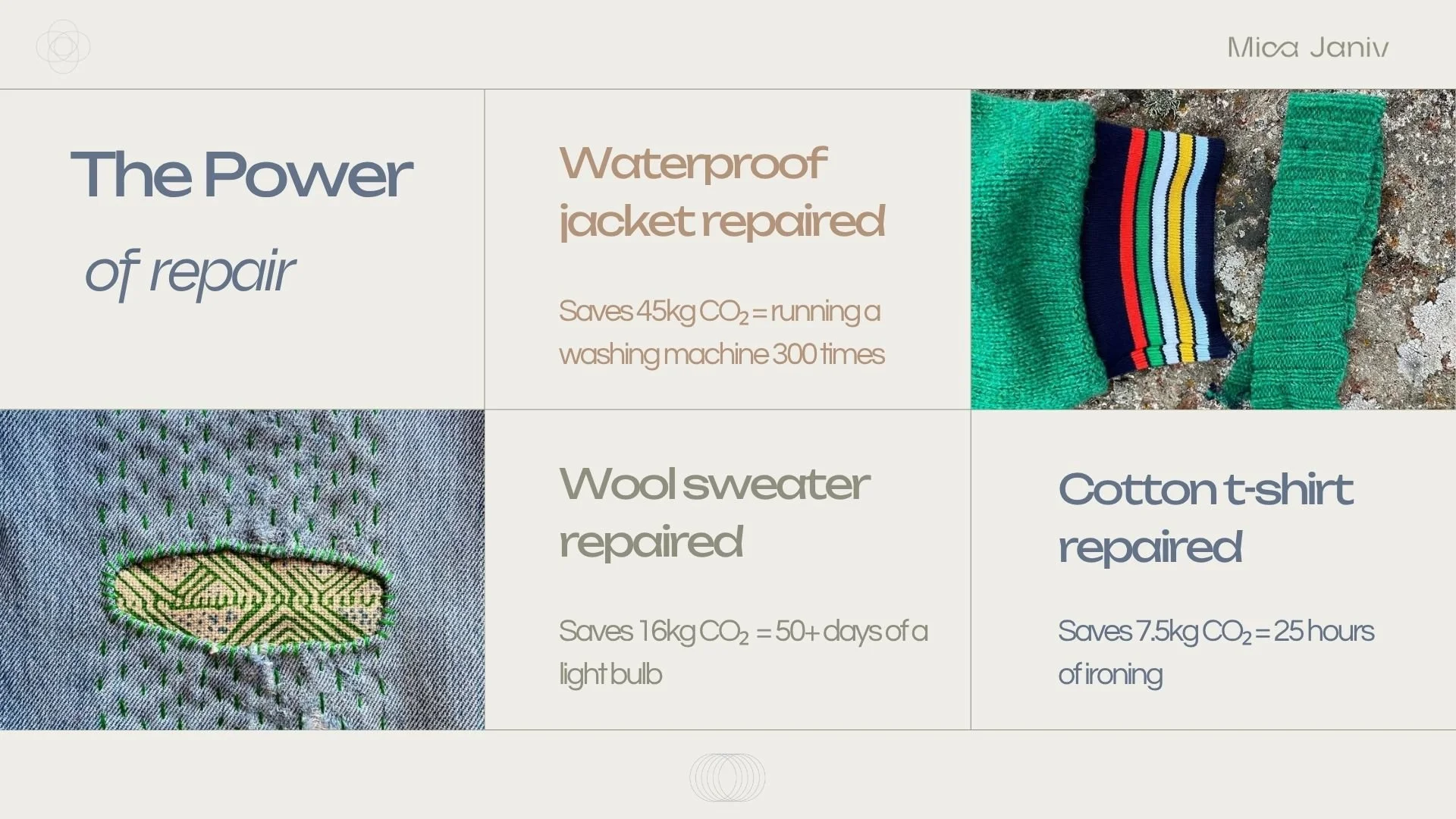
Images curtesy of Dolly Clothing, Lewes: https://www.dolly.uk.com
And here's the figure I’m excited about: 82% of clothing repairs directly displace a new purchase.
When you mend something, you are almost certainly preventing a new item from being produced. You are not just extending the life of your wardrobe. You are subtracting from the global production count.
The industry has spent decades making us feel like our choices are too small to matter. The research says otherwise.
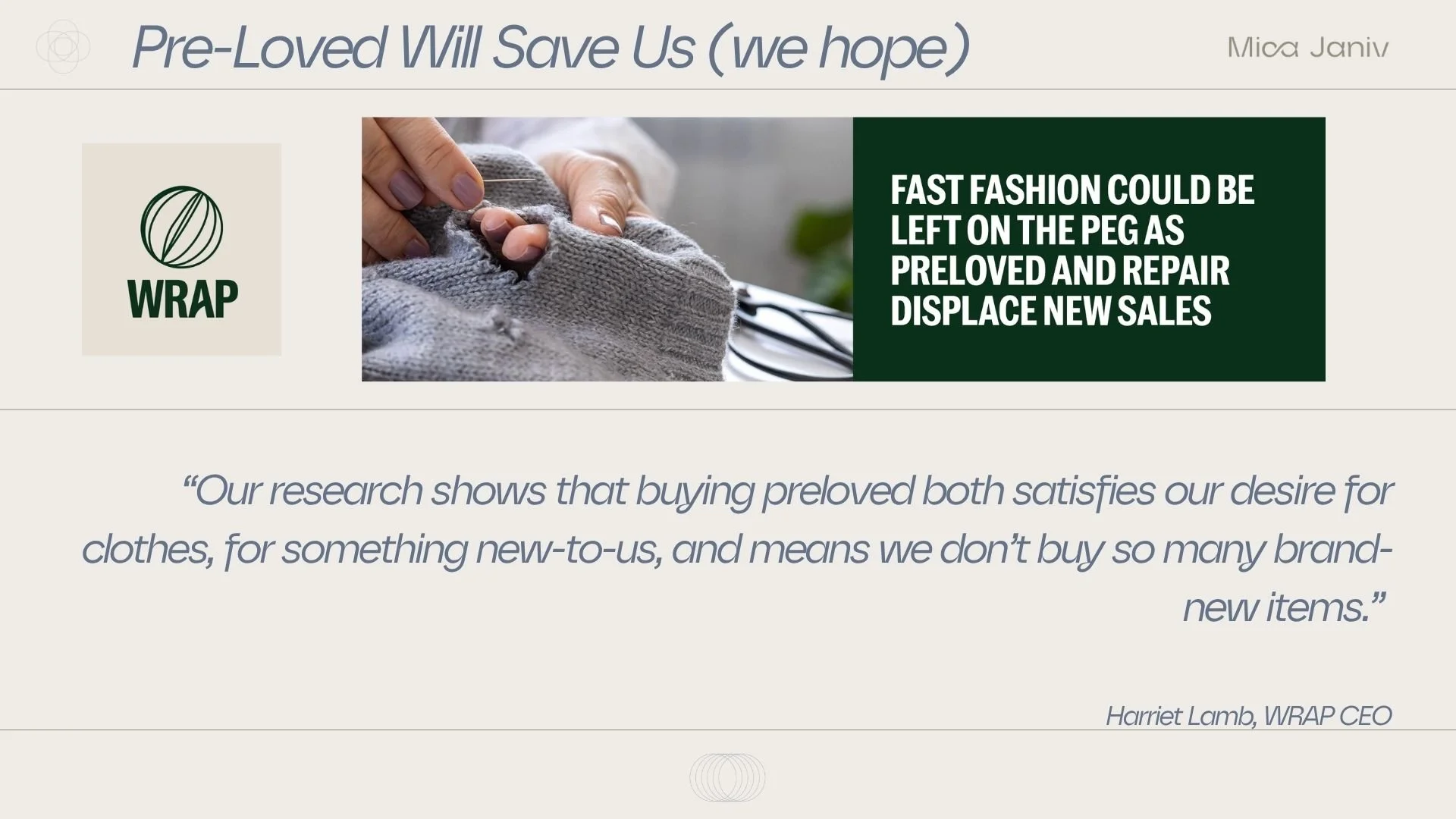
At the end of the talk, I pointed people to my friend and fellow fashion-activist, Diana Uprichard, who runs a zero-waste sustainable clothing hub, where she repairs clothes, teaches people how to sew, and much more besides. Bring her something that needs fixing. That's the whole talk compressed into one act.
Systemic change and local action are not in competition. We need the EU laws enforced, the UK to follow, the producers held to account. And we need DOLLY. Multiple actions. At the same time.
Sources
Fashion's Carbon Footprint
Fast Fashion and Emissions: What's the Link? — Earth.org (citing UNEP 2023 report)
Sustainability and Circularity in the Textile Value Chain: A Global Roadmap — UNEP, 2023
Fast Fashion: EU Laws for Sustainable Textile Consumption — European Parliament
Fashion and the Circular Economy — Ellen MacArthur Foundation
Charity Shop Donations
Expecting Charity Shops to Recycle Your Unwanted Clothes is Creating a Rubbish Pile — The Conversation, Violet Broadhead, University of Bristol, 2026
Waste Colonialism: Chile and Ghana
Chile's Desert Dumping Ground for Fast Fashion Leftovers — Al Jazeera, 2021
Chile's Atacama Desert Has Become a Fast Fashion Dumping Ground — National Geographic
How UK Fast Fashion Choices Are Causing an Environmental Catastrophe in Ghana — ITV News
Edward Bernays and the Engineering of Consent
Propaganda — Edward Bernays, 1928 (primary source)
Torches of Freedom — Wikipedia (Lucky Strike / feminist smoking campaign, 1929)EU Legislation
Parliament Adopts New EU Rules to Reduce Textile and Food Waste — European Parliament
Extended Producer Responsibility: What Fashion Brands Must Know — Greenstitch
The Power of Repair
WRAP: Textiles and Fashion — WRAP, UK Waste and Resources Action Programme
The UK Green Claims Code
Green Claims Code — Competition and Markets Authority