

The Greenwashing Directive is coming. Here's what every B Corp needs to know.
Reading time: 7 minutes | Topic: Regulation, B Corp, Sustainability Marketing
If your business sells to, markets in, or communicates with consumers in the EU, this matters to you. Even if you're based in the UK.
The EU's Empowering Consumers for the Green Transition Directive, known as the ECGT, comes into force on 27 September 2026. It bans a whole swathe of the environmental language that most businesses currently use without a second thought.
Words like 'eco-friendly', 'sustainable', 'green', 'carbon neutral' and 'nature-positive' are, from that date, either banned outright or only permissible with robust, third-party verified evidence behind them.
The ECGT is EU law, and it applies to any business selling or marketing to EU consumers, regardless of where that business is based.
For B Corps, there's an extra layer. B Lab has confirmed that B Corp certification (V1.6) is not necessarily ECGT-compliant. B Lab UK have asked all UK B Corps to ‘self-identify’ if your business is affected by the ECGT.
Let's break it down.
So what exactly is the ECGT?
In plain English, it does four things:
Bans generic, unsubstantiated green claims made to consumers. If you can't prove it, you can't say it
Bans carbon-neutral and net-zero claims based solely on buying carbon offsets
Bans sustainability labels, badges and logos that haven't been independently verified to a recognised standard
Requires any future sustainability commitment - eg, 'we'll be net zero by 2040' - to be backed by a specific, verifiable plan. Not a vibe. A plan.
The fines run up to 4% of annual turnover. The reputational damage, if you're caught greenwashing after loudly committing to better? Much, much worse.
Does this apply to UK businesses?
Yes, if you have any meaningful connection to EU consumers. The ECGT is EU law, and it applies to any business selling or marketing to EU consumers, regardless of where that business is based.
If any of these sound familiar, you need to take this seriously:
You sell products or services to customers in EU member states
Your website, social media or marketing materials are designed to reach EU consumers
Your products are stocked by EU retailers
You exhibit at EU events or appear in EU media
And even if the EU feels like a stretch, the UK's own rules are tightening in the same direction. The CMA's Green Claims Code already sets near-identical standards domestically, and January 2026 guidance extended legal responsibility to green claims made anywhere in your supply chain, including by your suppliers. The ASA updated its advertising guidance in October 2025. The direction of travel is clear. Tighter is the new normal.
What language is now banned?
This is the part that will require the most work for most businesses. The table below shows common green claims, why they fail the new rules, and what you should say instead.
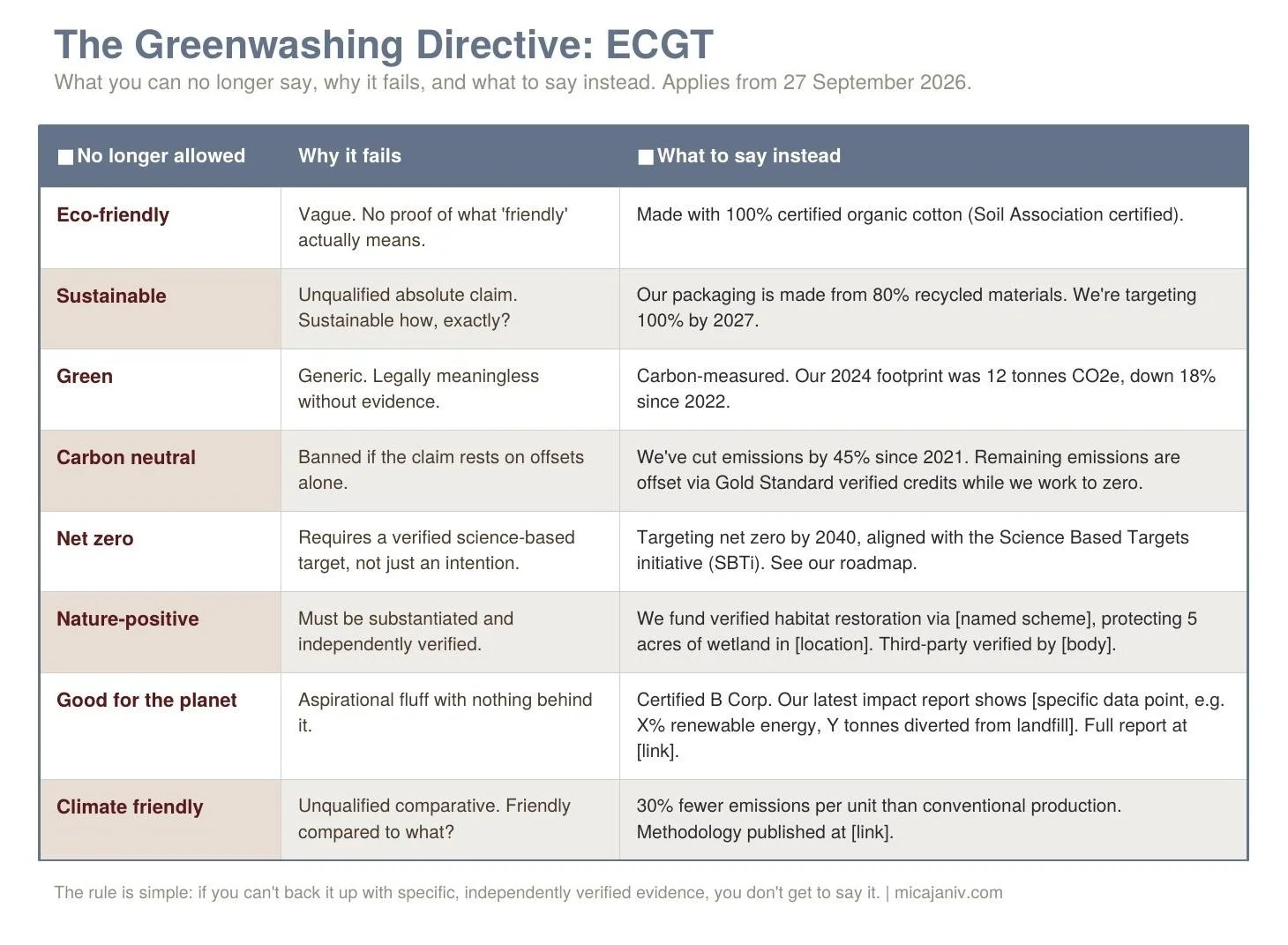
The principle is not complicated: if you can't back it up with specific, independently verified evidence, you don't get to say it.
B Corps: here's your specific to-do list
B Corp certification has always been about doing the right thing and being able to prove it. The ECGT raises the bar on that proof, and B Corp certification on the old standards (V1.6) doesn't meet it, because it uses B Lab's own standards rather than an independent third-party verifier.
B Lab has developed new standards (V2) and a new certification model that will meet ECGT requirements, using ISO-accredited third-party auditors. Here's what you need to do:
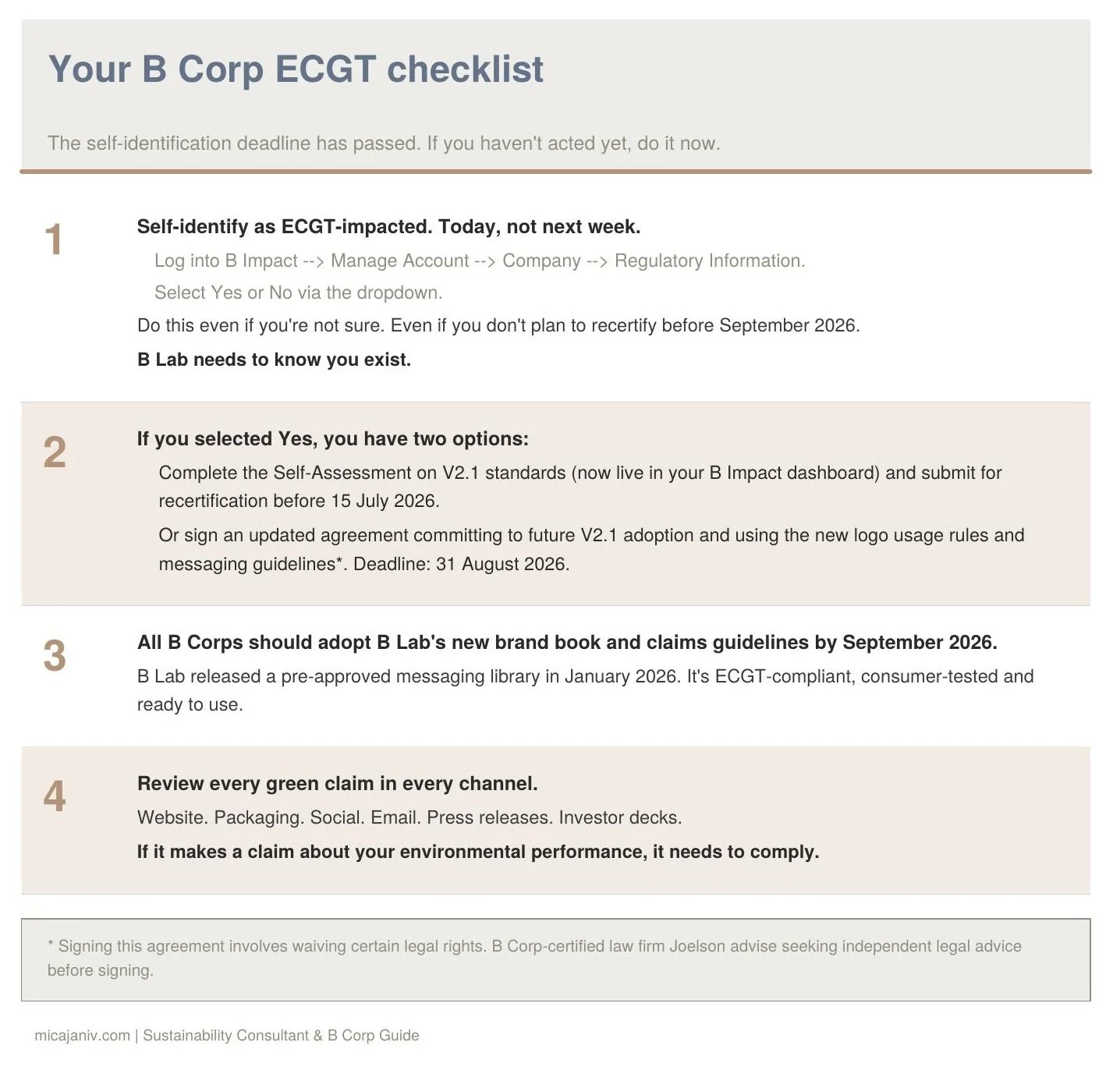
Note: If you are a client of mine, I’ve already done this for you.

Three things to do this month
Self-identify in B Impact if you're a B Corp operating in or marketing to the EU. Log in. Do it asap.
Audit your green claims on your website, packaging, social, email, even your email signature. Highlight anything that uses unsubstantiated language from the table above.
Brief your marketing team and arm them with evidence. Make sure everyone creating or approving copy & iconography understands these rules. Then build them an evidence file: your certifications, your data, your third-party reports, so every claim you make has something solid behind it.
Getting this right is not optional. But it is absolutely possible, and for businesses that are already doing the right thing, this is actually an opportunity. The companies that can substantiate their claims are going to stand out in a landscape full of businesses scrambling to change their language.